Your software says "VIN decoding." Your Parts Manager says "another return."
If you sell or use dealership software, you've seen the promise on every brochure: "VIN decoding capabilities." It sounds great. In practice it usually means the bare minimum — make, model and year.
But the right part isn't defined by make and model. It's defined by trim, engine, transmission, plant code and production run. That information lives in characters 4 to 9 of the VIN — the Vehicle Descriptor Section (VDS).
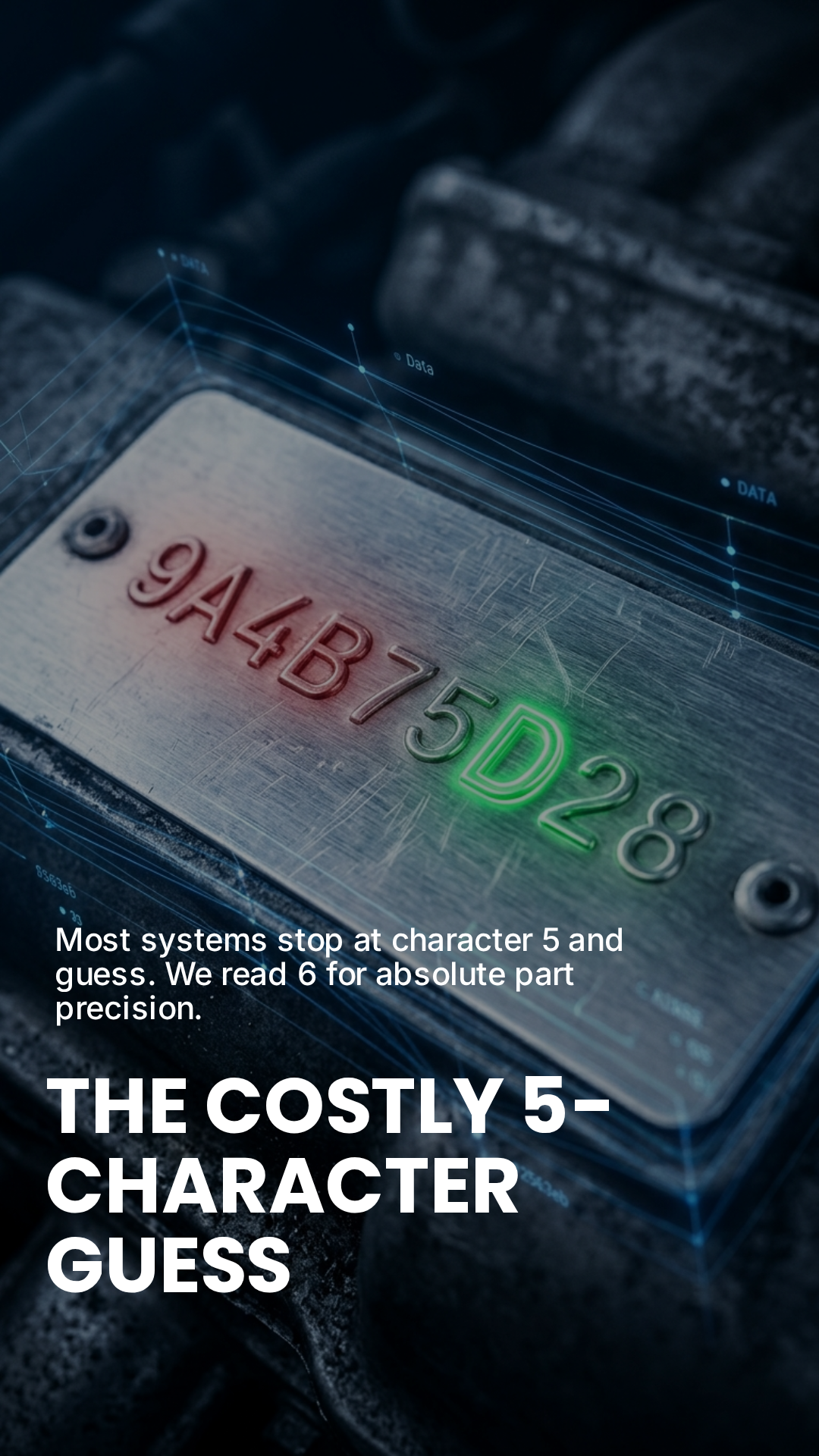
Generic decoders process 5 of those 6 characters and statistically guess the rest. For sales, that approximation is enough. For parts, it's the difference between closing the quote and processing a return.
What the VDS is and why all 6 characters matter
A VIN has 17 characters split into three blocks: WMI (manufacturer world), VDS (vehicle descriptor) and VIS (unit identifier). The VDS occupies positions 4 to 9 — six characters that encode the most relevant technical information to identify the right part.
Position 4-5: body and line. Position 6: series/trim. Position 7: engine type or restraint system. Position 8: powertrain variant. Position 9: check digit.
When a system decodes only 5 characters, the missing digit is often the one that distinguishes between two physically compatible engines that use completely different water pumps, sensors or filters.
- Positions 1-3 (WMI): country and manufacturer
- Positions 4-9 (VDS): six characters that define the right part
- Positions 10-17 (VIS): year, assembly plant and serial number
The real cost of the 5-character guess
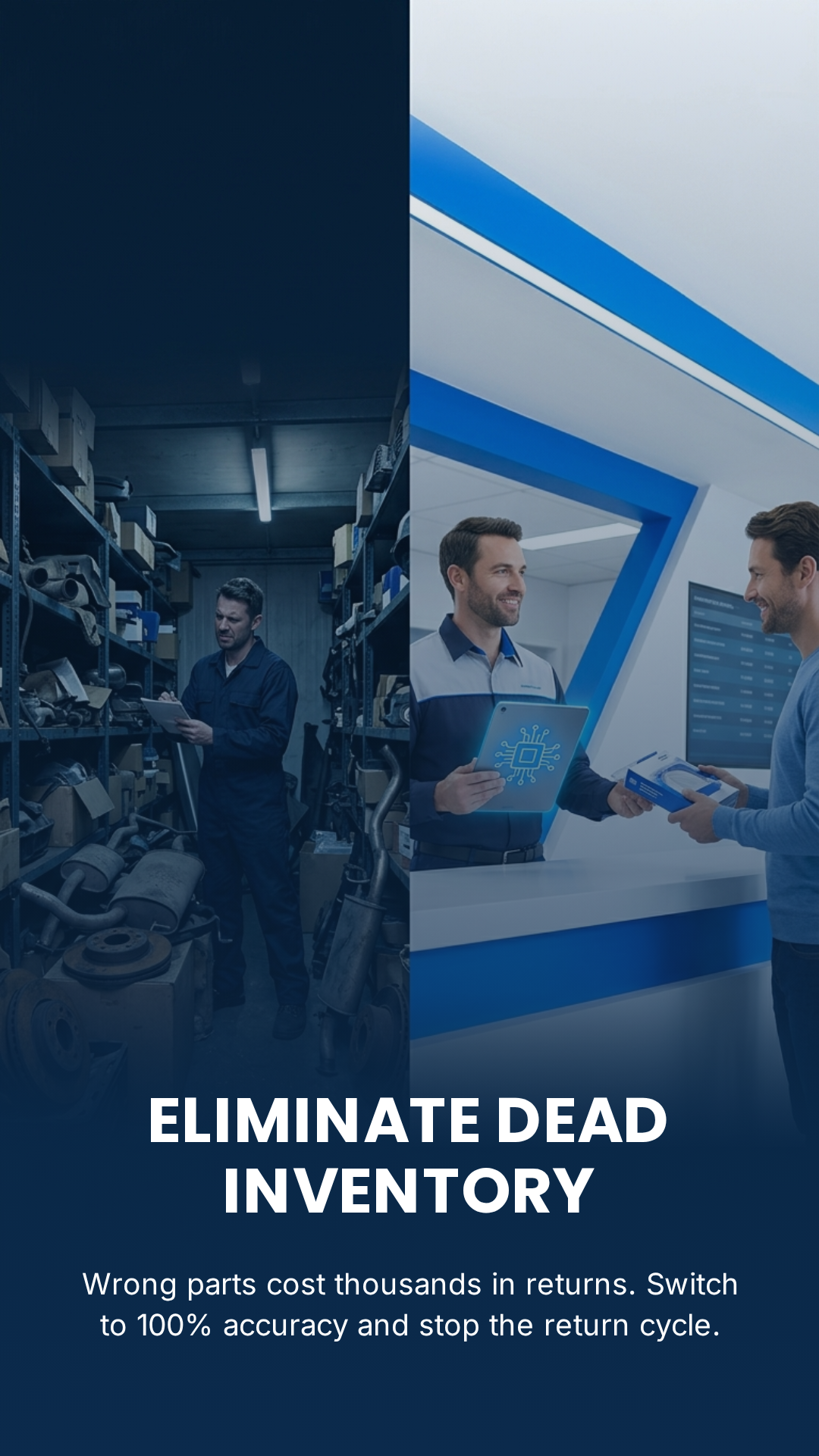
Let's run the numbers. An average dealership processes 800-1,500 parts orders per month. If the identification-error return rate sits at 15-25% (typical with generic decoders), that's 120-375 wrong parts every month.
Each return burns counter time, warehouse time, reverse logistics and often a supplier restocking fee. Conservative average: USD 35-80 per return, before counting reputational damage and service bays sitting idle waiting for the right part.
Multiply it: a mid-size dealership leaks between USD 4,200 and USD 30,000 per month in avoidable returns. Annualized, up to USD 360,000 lost over one mis-decoded VIN variable.
- Dead inventory growing on the shelves
- Service bays stalled waiting for the correct part
- Frustrated customers that don't return for the next service
- Parts advisor time wasted on re-quotes
Case study: 17 characters vs 6 characters = USD 340 per return
OEM parts distributor in Mexico, ~1,200 orders/month via WhatsApp and counter. Before deploying AutoParts AI Agent, the team decoded the full VIN (17 characters) using a generic web tool that returned make, model and year — but failed to differentiate trim or engine variant from VDS characters 6-9.
Typical week: 287 quotes, 41 wrong-fitment returns (14.3%). Each return averaged USD 340 across stuck inventory, reverse logistics, supplier restocking fee and advisor hours. Weekly loss: USD 13,940. Annualized: ~USD 725,000.
After switching to full 6-character VDS decoding with direct EPC cross-reference: 312 quotes the next week, 5 returns (1.6%), all unrelated to identification (customer changed their mind). The parts advisor reclaimed ~18 hours per week previously burned on re-quoting.
The delta wasn't marginal: going from 5 to 6 VDS characters eliminated 89% of identification-error returns in the first month. Pilot ROI closed in 23 days.
- Before: 14.3% returns · USD 13,940/week lost
- After: 1.6% returns · 89% reduction
- Parts advisor: +18 hours/week freed
- Pilot ROI: 23 days
How the EITSERV AutoParts AI Agent fixes it
We built the AutoParts AI Agent precisely to fix the problem legacy systems ignore. Our autonomous AI orchestration doesn't guess: it extracts all 6 VDS characters and cross-references them against Electronic Parts Catalogs (EPC) connected directly with the manufacturer.
The agent combines deep VIN decoding, OEM database validation and conversational reasoning to confirm trim, engine and market. If ambiguity exists — say, a unit produced in two different plants — the agent asks naturally instead of assuming.
Operational outcome: 100% first-attempt match rate in pilots, returns dropped below 2%, and a parts advisor who goes back to selling instead of correcting.
Zero guessing
Full reading of all 6 VDS characters before quoting.
Direct EPC connection
Cross-referenced with official manufacturer catalogs.
Returns < 2%
From the typical 15-25% to under 2% in pilot.
More fixed ops profit
Each prevented return is USD 35-80 saved directly.
Advisor freed
Your parts team sells again instead of fixing errors.
Three common mistakes when decoding VIN for parts (and why we solve them differently)
After running our agent in production against real OEM catalogs, we've identified three patterns that break most VIN decoders on the market. Sharing them at the right level helps any fixed ops team better evaluate their current software.
- Mistake #1 — Treating the check digit as model information. Position 9 of the VIN is a math-generated control digit (ISO 3779 / SAE J853): it validates that the VIN was typed correctly, it doesn't carry fitment data. Decoders that include it in their lookups generate constant noise and miss the right part. Our agent isolates it before any catalog query.
- Mistake #2 — Ignoring driving direction. A single unit can declare left-hand or right-hand drive variants, while OEM catalogs typically index the chassis under its base form. If the system doesn't reconcile both, it returns 'no coverage' to customers who actually do have parts available. Our agent normalizes these variants before searching.
- Mistake #3 — Assuming VIN structure is universal across plants. Models built in regional plants (Mercosur, Thailand, South Africa) encode body and trim differently from Japan or the US. Without an explicit per-plant model, two completely different vehicles can map to the same chassis. Our agent treats each plant as its own domain with rules validated against the official source.
Direct EPC connection, not generic databases
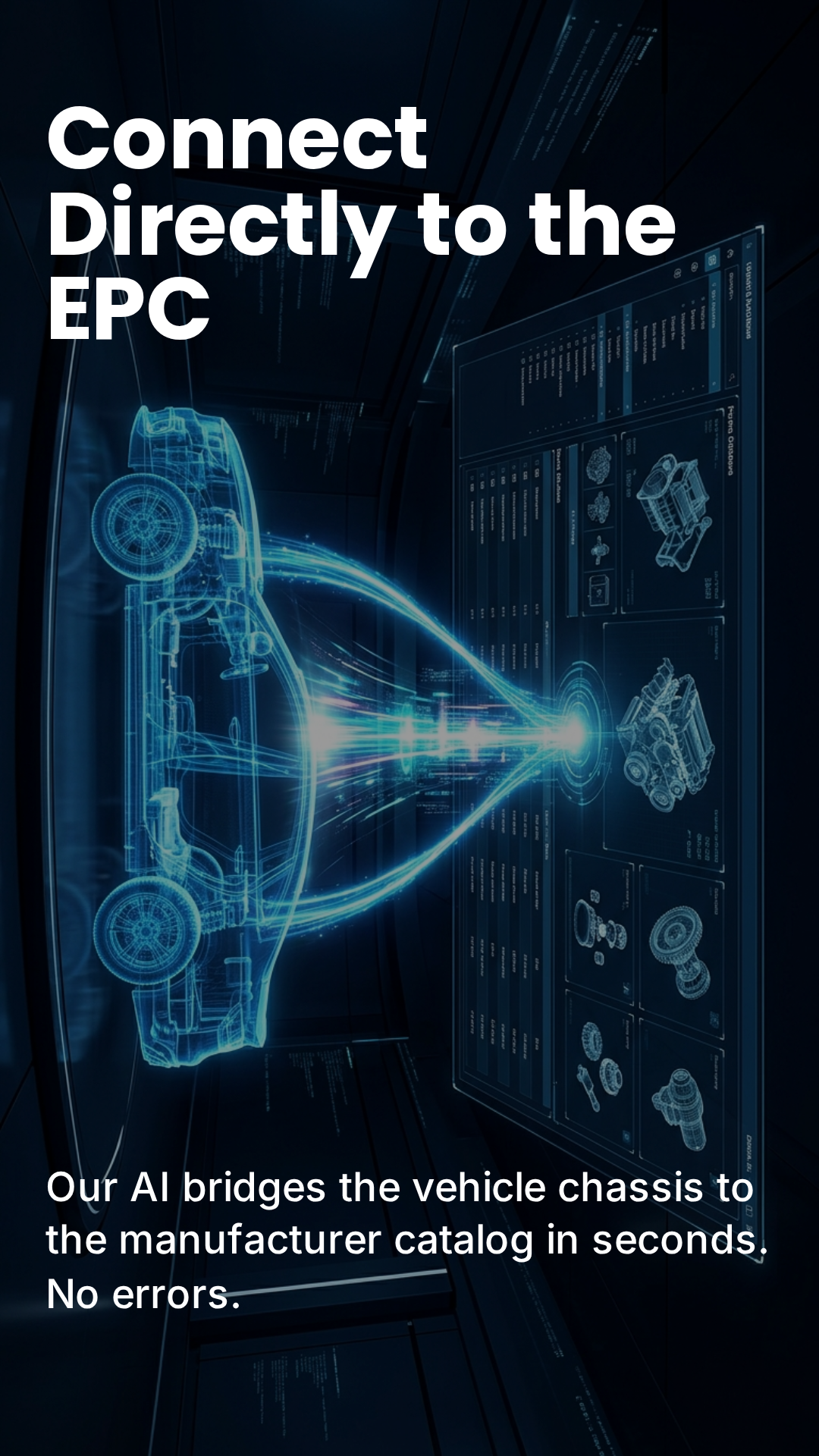
The difference between a generic decoder and the AutoParts AI Agent isn't only how many characters it reads, but what it compares them against. Traditional solutions query public databases like NHTSA or aftermarket aggregators that can lag by weeks or months.
Our agent cross-references information directly with the manufacturer's official Electronic Parts Catalogs (EPC). That means when there's a mid-year part-number change or a specific production run, we detect it instantly.
For the Parts Manager that translates into quotes with the exact OEM number, real availability and validated aftermarket equivalences — all in seconds, via WhatsApp, web or the dealership ERP/DMS.